
The BET method quantifies surface area by analyzing how gas molecules adsorb in multiple layers on your sample’s surface, extending Langmuir’s single-layer model physisorption. You’ll prepare a dry, contaminant-free sample, degas it, and measure adsorption at controlled pressures and temperatures. By identifying the linear relative-pressure range and performing regression, you calculate monolayer capacity and specific surface area. This precise technique is essential for understanding material porosity, though it assumes ideal kinetics and may miss complex pore connectivity effects. Exploring further reveals how BET informs material design and adsorption behavior.
Principles Behind the BET Method
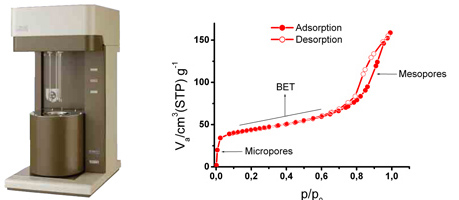
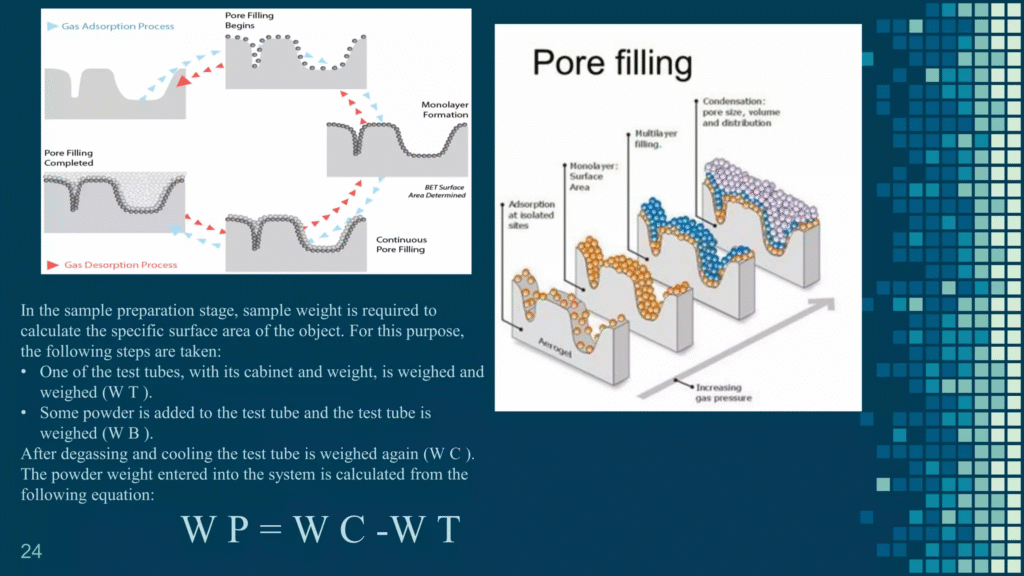
Although it might seem complex at first, understanding the principles behind the BET method is essential for accurately determining surface area. You’ll find that the BET theory extends Langmuir’s adsorption model to multilayer adsorption, quantifying how gas molecules adhere to a solid surface. Critical to this process are adsorption kinetics, which dictate the rate at which molecules adsorb and desorb, affecting equilibrium and measurement accuracy. Additionally, pore connectivity plays a crucial role, as interconnected pores influence gas diffusion and the overall accessible surface area. By analyzing adsorption isotherms, you can extract precise surface area values, considering how multilayer formation and pore structure impact adsorption behavior Lab Alliance. Mastering these principles grants you the freedom to interpret BET results with confidence, ensuring reliable surface characterization.
Experimental Setup and Procedure
Before you begin the BET surface area analysis, it’s essential to make certain that the experimental setup is meticulously prepared. Start with rigorous sample preparation: guarantee the sample is dry, homogeneous, and free of contaminants that could skew adsorption measurements. Proper degassing under vacuum removes adsorbed gases and moisture, stabilizing the baseline. Next, focus on instrument calibration; verify pressure transducers and temperature sensors are accurately calibrated to maintain measurement fidelity. Confirm the adsorption apparatus is leak-free, and the cryogenic fluid level is adequate for consistent temperature control. Precise control of relative pressure during nitrogen adsorption is critical, so validate system responsiveness before running your analysis. By methodically preparing the sample and calibrating the instrument, you establish a robust foundation for reliable and reproducible BET surface area measurements.
Data Analysis and Interpretation
Once you’ve completed the adsorption measurements, you’ll need to analyze the data using the BET equation to determine the specific surface area. This process demands careful data preprocessing to eliminate anomalies and secure accuracy. You’ll apply statistical modeling to interpret the linear region of the BET plot effectively. Precision here is key to avoid miscalculations.
Focus on these critical steps:
- Normalize adsorption data for consistency
- Identify the linear pressure range for valid BET application
- Perform linear regression to extract slope and intercept values
- Calculate monolayer capacity and convert it into surface area
Applications of BET Surface Area Measurement
Accurately determining the specific surface area through BET analysis provides invaluable insights for various scientific and industrial fields. When you apply this method, you gain a quantitative understanding of pore size distribution, vital for catalysis, adsorption processes, and material design. BET surface area measurement enables you to evaluate adsorption kinetics effectively, revealing how molecules interact with surfaces over time. This data is essential for optimizing adsorbents, pharmaceuticals, and porous materials. By interpreting BET results, you can tailor material properties to enhance performance and efficiency in applications like gas storage, filtration, and sensor development. Mastery of BET analysis empowers you to innovate, ensuring your materials meet precise functional requirements while maintaining control over structural characteristics related to surface phenomena.
Advantages and Limitations of the BET Technique
While the BET technique offers a robust framework for quantifying surface area, it’s important to recognize both its strengths and constraints to apply it effectively. You’ll find that BET excels in delivering reproducible surface area data for a wide range of materials, yet it assumes multilayer adsorption without accounting for complex pore connectivity. This can affect accuracy, especially in heterogeneous or microporous samples where adsorption kinetics vary markedly.
Consider these key points:
- Provides reliable surface area estimation for mesoporous materials
- Limited sensitivity to pore connectivity and micropore structure
- Assumes ideal adsorption kinetics that may not represent all materials
- Interpretation requires careful selection of relative pressure range
Understanding these factors helps you leverage BET’s advantages while mitigating its limitations in your surface characterization efforts.
Conclusion
By mastering the BET method, you gain a reliable approach to quantifying surface area with precision, essential for material characterization. Understanding the underlying principles and carefully conducting experiments guarantees accurate data interpretation. While the technique offers broad applicability across various fields, you should remain aware of its limitations, such as assumptions in adsorption behavior and surface homogeneity. Ultimately, employing BET thoughtfully enhances your analytical capabilities in surface science and materials engineering.